l s

Friday, December 12, 2008

Natural pigments

I love this blog from colourlovers.com on prehistoric colors and natural pigments still in use today. The photo of the earth colors in their natural state is amazing. A student in one of my classes some years ago had collected these pigments in Italy and brought them to show us--incredibly beautiful.

Speaking of pigments, I finally got around to checking out four more M. Graham watercolors on my chart. All are richly pigmented and I liked them, except I didn't find the Manganese Blue Hue to be near enough to the original to merit the name. However, it's a beautiful color and would work well as a cyan in an expanded palette. The Cadmium Yellow Deep is rich and opaque, and I love the Permanent Green Pale. I don't care much for the phthalocyanine greens in the yellow shades, but this one is a different mixture. Clear and bright. The M. Graham Terra Rosa is opaque, like Indian Red in other brands. I like this color for Southwestern themes. My chart is complete, except for Mineral Violet. One of these days I'll run across it, I'm sure. If I have it, it is buried somewhere in the vicinity of my drafting table. Know what I mean?

Labels: , ,

Tuesday, May 08, 2007

Pigment intensity in watercolor

For my watercolor class yesterday I demonstrated intensity, which is the difference between bright and dull colors. For some reason this is hard for a lot of artists to understand--that paint in a tube is high intensity or low intensity before it is mixed with another color. Several have used yellow ochre as the only yellow on their palettes and wonder why their paintings don't seem bright.

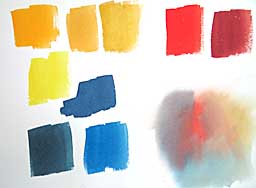
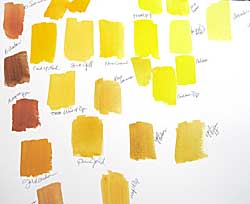
This chart shows what I did. I painted a swatch of yellow ochre at top-center. Then I made a swatch of gamboge to the far left leaving a space between them. The difference in intensity was obvious. Between the two I made a swatch of quinacridone gold, which they could see is brighter than ochre, but not as bright as gamboge. (Just below the gamboge is a cool lemon yellow, but I didn't emphasis the temperature difference, as that will be a later lesson.)
I continued the comparisons at the top-right with bright vermilion and low-intensity brown madder. In the lower left corner I painted indigo at left, phthalocyanine blue red shade to the right of indigo and indanthrone Blue just above. Again, the differences in intensity are obvious. But this was a revelation to many students, who hadn't previously observed this in their paints.

The mingling at the lower right shows how I test color schemes to see if I like the combinations, which I do when I begin a painting. I drop a little of each color onto damp paper, then push them around a bit to see what mixtures they make. This combination uses the low-intensity colors: brown madder, yellow ochre and indigo. I dropped in a tiny bit of vermilion to jazz up the brown madder. The low-intensity colors surrounding it make the color sing. This looks like an exciting combination for a painting.

Note: The colors on your monitor don't match the paints perfectly, so you need to do your own swatches. Also, brands may differ greatly in pigments having the same name.

Labels: , , , , ,

Tuesday, February 06, 2007

Request for paint names on the color wheel

A blog reader asked me to post a larger version of the pigment color wheel so she could read the labels on the colors. Believe it or not, it's better if you don't know the names. The value of the exercise is in using your own paints and testing them to see where they fit on your color wheel. When you buy new colors, before adding them to your palette, add them to your pigment wheel so you can see their relationship to your other colors. Paints with the same names may be very different in various brands. Not only that, what you see on the monitor or in a printout is not a true match for the actual paint color.

I've blogged before about split-primary color-mixing, which may help you if you're struggling with mixing. You'll find just about everything else you need to know about color mixing in Exploring Color. There's even a pigment wheel with color labels on it. Just remember, the printed colors aren't matches for the pigments.

Labels: , , , , ,

Friday, February 02, 2007

The pigment color wheel is finished

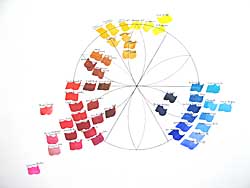
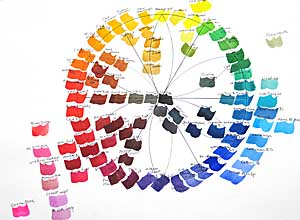
Finally I've finished the watercolor wheel I started for my class several weeks ago. I did blue first, then added red the following week and yellow a week later. (Click on the "color wheel" label below to see the three work sheets and watercolor wheels that I painted last month.) Today I filled in orange, green and violet secondary colors and the neutrals in the center. I finished it in my studio so the class wouldn't lose painting time next week. I'll show them the finished wheel, explain a couple of things and they can examine it more closely later if they wish. Mind you, I'm not advocating having or using all these colors. I want to show that there's a continuum around the color wheel that reveals temperature relativity from one color to the next. This is a good exercise for your "color eye," to see if you can distinguish between warmer and cooler colors and see how their neighbors on the wheel influence their temperature. The colors around the perimeter of the wheel are mostly high tinting-strength, high-intensity colors. Except for a few colors in the red area, outside the perimeter are the low tinting-strength, high-intensity colors. Inside the wheel are the low-intensity colors and neutrals.
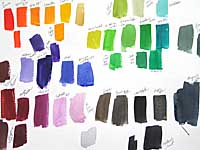
Here's the test sheet for the colors I did today. It doesn't matter whether you make a wheel or swatches, but this is a good way of learning about your paints. As I said in an earlier post, the color wheel above is similar to the one I made for my first Exploring Color book, published in 1985.
Labels: , , , , , , ,

Tuesday, January 23, 2007

Yellow hits the charts


Yesterday we explored yellow watercolor paints, working at discerning between the warm and cool yellows. We all know that yellow is a warm color, but which are warmer and which cooler? Some of them are very close and will no doubt differ between brands. I added in several earth colors, some of which ended up closer to orange than yellow, so that's where I put them on the wheel below.

On the chart above the cool yellows are on the right of the paper and the warms on the left. On the color wheel at right the cool ones are heading toward blue (right) and the warm ones are heading toward red (left). When you're mixing colors, yellow is a hard color to darken without changing it into a greenish-olive or a muddy brownish color. It sometimes works better to use the yellows and yellow-oranges in the earth colors toward the center of the wheel to darken yellows. The mixtures are richer.

Labels: , , , , , ,

Sunday, January 21, 2007

Seeing Red

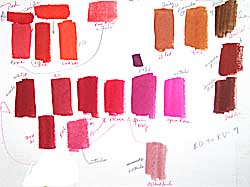
Last Monday we explored reds in watercolors, as we did last week with blues. Here's the chart that I did in class, explaining the paint characteristics of each pigment and the relative temperature as I went along. I let the class help me decide where a color belongs. I wish we had full-spectrum lighting in our classroom, because the colors tend to look "off" and I have to remember to mention this. Lighting makes a huge difference when you're exploring colors.
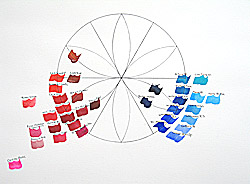
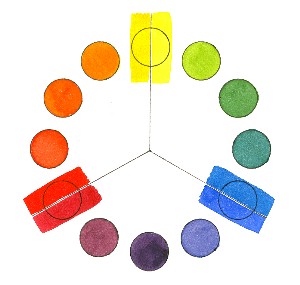
This color wheel gives a better idea of where the colors fit in the continuum around the wheel. The ones on the circle are the best match I can make to the ideal colors. There may be better ones, but I'm just using the ones I have. The colors toward the center are darker, earthier variations of the wheel color. The center color will be black. Around the edges are variations of the main colors, some with weaker tinting strength. Way out at the edge on the left is Opera Rose, a color that is fluorescent and doesn't really fit with the others.
The completed color wheel is shown in my Exploring Color book, first published in 1985 and revised in 1998.

Labels: , , , , , , ,

Monday, January 08, 2007

Singin' the Blues

We almost had a full house for the first session of Exploring Watercolor at Hithergreen Center today. Twenty-one returning students, three newbies, one absentee recovering from surgery and one perpetual absentee. (Don't ask.) I decided to get them more involved with different paints. Most have been with me for two or more years and have had the basic color-mixing exercises. Some have tried other colors and others are still using the basic palette. So today we started with the blues. I should have organized the chart, but just put the colors down as I talked about them, so I hope I can reconstruct the thing and tell you the colors in the accompanying illustration.

Top row: Cobalt Blue, Phthalo Turquoise
Second Row: Winsor Blue (Red Shade), Winsor Blue (Green Shade), Cerulean Blue (Red Shade), Cerulean Blue, Ultramarine (Green Shade)
Third Row: Cobalt Turquoise Light, Manganese Blue Hue, Manganese Blue (genuine), Rembrandt Turquoise Blue, Cobalt Blue, French Ultramarine
Fourth Row: Cobalt Blue Deep, Indigo, Indanthrene Blue, Cobalt Blue Deep
Please note that web colors cannot accurately represent paint colors, so the colors shown aren't exact matches for the chart.

We talked about color temperature, discussing the positions of the blues relative to blue-green, which in theory is the coolest color on the color wheel. I also talked about the transparency or opacity, staining property and tinting strength of each pigment. You will find more information on these properties of paints on my web site here and here, and also in my book, Exploring Color.

This was great fun for me and the class asked great questions. Several said they're looking forward to a new color next week.

We're going to do a color per week for awhile to familiarize them with those they haven't used yet. By the time we're finished, they should be able to find the right place for any color they choose.

Labels: , , , , , , ,

Thursday, March 16, 2006

Exploring options in color

I'm always amused when I'm teaching a new class, whether in watercolor, color, collage or design, to find students who firmly avow that they do things in a certain way and aren't about to change. This isn't typical of every class, but now and then one shows up. All I can do is think to myself, "So, why are you here?" I try to be flexible and help them do what they want to do. Sometimes they come around to trying something different and sometimes they don't. We'll see how this plays out in my current color class. Most of the students are working on pigment studies and learning a lot about paint characteristics. A couple have skipped lightly over these, one saying she already knows all that and the other insisting that she is happy with her limited palette and doesn't like all the bright colors, which hurt her eyes. The first I gave an assignment to paint the four seasons using a different set of primaries for each one to better express the qualities of the season through color. She said, "I always use the same colors for all my paintings." Period. End of discussion. I asked her to try it, showing how Phthalo Blue makes a cooler, more wintry sky than French Ultramarine; how Lemon Yellow with Phthalo Blue makes a spring-ier green for trees. She agreed to try it, but I didn't feel she was happy about it. I looked at her sketches about halfway through and could see the seasons revealed in her colors. She finished them off beautifully and I think she was pleased, albeit a little grudgingly. I found the second student looking at pure-hue color wheels in my workbook and holding her head, as if in pain. She says she just wants to learn to use the colors she has. She doesn't think she needs more colors, because she can do what she wants with what she has to mix naturalistic landscape colors. I turned the workbook to a page where six color wheels show different combinations of primaries, including earth hues. In about two seconds she decided she had to have Indigo and maybe a couple other colors on those wheels. I think both are on the way to opening their minds about exploring color options to get more excitement in their work. We'll see in a couple of weeks what the next challenge brings.

Labels: , , , , , , ,

Monday, March 13, 2006

What do you know about your paints?

It's astounding how many artists reply, "Nothing" or "No more than I have to know." It isn't that hard to learn the composition of your paints, their handling characteristics, and how different brands compare, but it can sure save you a lot of grief in your painting (and a few dollars in your wallet) if you take the time to do it. Most people accept printed brochures from paint companies as their guides, without realizing how much difference there is between a printed color and a painted swatch. That's why I wrote Exploring Color --to offer a method for learning about paints and using them creatively. I'm teaching an eight-week class how to explore their colors. The main benefit of such a class is having scheduled time to do the charts and comparisons. I'm seeing a lot of "aha!" expressions as the students work their way through the colors and charts. They have homework, too, because the class falls a few hours short of my five-day workshops and I want to give them the full program. At the end they'll know how NOT to make mud, how to test their paints, and how to use many different palettes for expressive painting.

Labels: , , , ,

Thursday, March 02, 2006

Exploring basic color theory

split-primary color wheelI can tell this is going to be a good class. Aside from the fact that four people arrived late (sigh!) and three were on vacation (a given in Ohio in the winter), the orientation went well. Lots of good questions, several aha! moments and a few jaw-dropping, I-had-no-idea reactions to color facts and theories. Great fun for me! I showed slides on the history of color in art because I think it's very helpful to see where color started (30,000 or more years ago) and how it evolved from decorative and symbolic to representational and expressive. I wound up the session with the split-primary color-mixing system from my book, Exploring Color, showed them how to mix the wheel, explaining the theory behind it. They have homework (groan!). Everyone must study the properties of color and do the charts and color wheel. It will be interesting to see how many get it done. Next week we're going to learn all about paint--characteristics of pigments, paint quality, differences in brands, and more. I love this workshop.

Labels: , , , , , , , ,

Wednesday, January 18, 2006

More on paint

Yesterday another artist responded to my friend's question about "spectrum" paint colors. His response was highly technical and in the end referred the artist to handprint.com, which I've recommended previously in my blog. This site is the be-all and end-all of information on watercolors. However, in browsing the site again I've decided a lot of it is way too technical to be of use to most painters. I hope you'll use the site without being intimidated by too much information. You can learn more by testing your own paints yourself and deciding what you like.

Labels: , ,

Tuesday, January 17, 2006

Spectrum colors in paint

An artist friend queried a watercolor group today about what the term "spectrum" means when it's used in a paint name. Here's my reply: "Spectrum" colors in paint are a myth. You can't have spectral color except in light. This is one company's idea of a "true" color, whatever that is. The same is true of colors labeled "primary" this or that. What's primary? If you collected them all and compared them you'd realize there is no standard in paint and the terms are meaningless. Best to stick with pigment names and numbers. Even then, you'll find that some paints with the same name and number vary widely from brand to brand. He responded that he had found that Raw Sienna in M. Graham and Cotman are very different and he had a definite preference for one over the other. Artists need to make such comparisons themselves and not assume that another brand will be the same as the one they prefer. Manufacturers' printed paint charts aren't much help. Colored inks don't do a very good job of reproducing paint colors. If a painted chart is available, you can see the actual color and judge your colors better.

Labels: , ,

Thursday, November 10, 2005

Watercolorist's best friend

Bruce MacEvoy of handprint.com has a spectacular site with everything you ever wanted to know about watercolor. He has informed me that Grumbacher (now owned by Sanford) is no longer making Grumbacher Finest watercolors. Whatever you find online or in the stores is the last of it. If you're a Grumbacher Finest fan, now's the time to test other paints for suitable substitutes for your favorite colors.

Labels: , ,

Thursday, October 20, 2005

Artist vs. student watercolors

My recommendation is always to use the best paint you can. Cheap paint has additives that weaken the pigment load. You have to use more paint and brush strokes to get the intensity you want instead of getting it right the first time, as with richer artist colors, which take far less paint to make intense color.

Is there any advantage at all to using cheap paint? Here are some scenarios:

You like pastel tints and hate staining colors. Buy cheap pan paints and hope they don't fade.
You love intense, staining colors and don't care about the quality. Use cheap tube colors made with synthetic dyes. Test for lightfastness.
You love richly pigmented, dense, velvety color. Use paints that don't have ox gall in them.
You hate pale washes and want rich color from every brush stroke. Use well pigmented artist colors.
You like to use unusual, exciting colors. Choose from manufacturers that have more than 50 colors in the line.
You use pouring techniques to build up thin layers of paint. Use small amounts of artist colors or large amounts of cheaper paints.
You use heavy layers of paint. Use cheaper paints if they don't show a tendency to crack.
You like a creamy, non-sticky consistency to paint. Avoid honey-based paints.
You like watercolors that won't dry and crack when left on the palette. Avoid cheap paints.

My personal preference is for paints that are highly pigmented and creamy, not juicy. I've tested many brands of watercolor and my A-list consists of Winsor & Newton (not Cotman), Holbein and Daniel Smith. Also of high quality are Rembrandt, Rowney, Old Holland, Sennelier and Schmincke. Included in the top tier are Maimeriblu and M. Graham. Artists all have their preferences, so this is a matter of opinion and experience, not carved in stone.

Labels: , , ,

Tuesday, October 18, 2005

Urban Myth: Blue and Yellow Don't Make Green

Have you fallen for that one? If so, you probably don't mix greens but use tube greens like phthalo, Hooker's or sap green instead to be on the safe side. It's likely that your greens all look pretty much the same and are somewhat unnatural-looking. No matter what your subject matter, if you paint realistically you want your greens to have the variety you see in nature.

Let's debunk the myth about blue and yellow. There are innumerable beautiful pigment variations of these two colors that will make every green you can possibly imagine. A simple rule of color theory will help you mix the green you want: When mixing a secondary color (green) from two primaries (blue and yellow), avoid the third primary (red), which is the complement (opposite) of the secondary mixture (green).

For example, to mix bright greens use cool pigments: phthalo blue and cadmium lemon or Winsor Lemon. To mix low-intensity natural greens, use ultramarine and any warm yellow, such as New Gamboge, cadmium yellow medium or Indian yellow, which all have a hint of red that knocks the intensity down a bit.

If you still like to use tube greens occasionally, tone them down by mixing with any color that has a reddish cast, such as burnt sienna, or a touch of alizarin crimson or cadmium red.

Labels: , , , , ,

Monday, October 17, 2005

Problems with color in art prints

An artist asked me recently why his art prints seemed duller than the original painting. We discussed his palette and found what I believed to be the culprits: Opera and French Ultramarine. Opera is a bright fluorescent pink. Like all fluorescent colors, Opera is outside the "gamut," or range of colors that can be reproduced with accuracy. French Ultramarine isn't fluorescent, but it can't be reproduced accurately with four-color process and ink-jet printing, which use cyan, a greenish-blue. Most greens mixed with French Ultramarine and yellow are somewhat grayed in printing because of the red bias of this blue pigment. If you know your color theory, you know that mixing all three primary colors neutralizes color mixtures.

It's disappointing to spend time on a painting that turns out well but reproduces poorly. To get the best colors in prints, create your painting with colors similar to those used in printers' inks: magenta, yellow and cyan. In recent years manufacturers have offered artists good matches for these colors in pigments. Quinacridone Magenta is a close match, but you can also try Permanent Rose or any other bluish-red. Any yellow that isn't too orange or too green will work, such as Transparent Yellow or Hansa Yellow Light. The best cyan I've found is Winsor Blue Green Shade, which is about the same as Thalo Blue. You need a greenish-blue. Using a limited palette of "safe" colors will assure that your print will match your painting.

Even if you don't plan to print, it's wise to use a somewhat limited palette; you don't have to worry about the color gamut. Here's more on limited palettes and using triads in painting.

Labels: , , , , ,

Sunday, October 09, 2005

Ramblings on watercolor and gouache

Both watercolor and gouache are water media. Theoretically, the difference between them is that with transparent wc you work light to dark laying thin glazes and washes on paper; gouache is opaque (dense), so you build up layers with brushstrokes, working dark to light. In actual paints, however, the distinctions are not so clear. Pigments used in all media are generally the same, so if you're using a certain color in watercolor, it's made from the same pigment used in gouache, oil or acrylics.

It's confusing to watercolor painters to learn that some pigments in transparent watercolor are highly opaque, for example, the cadmiums, cerulean blue and chromium oxide green. These pigments are naturally opaque, so they have more covering power than most watercolor paints. But they aren't as dense as gouache. Gouache has additives that make the paint more dense and opaque.

A gouache painting looks more like an oil or acrylic than a watercolor, although it's possible to make a watercolor that looks like gouache simply by using less water and more paint. The concern with either method is that thick paint may crack or break off the surface, which is one reason a more rigid support is needed, such as heavy illustration or watercolor board.

Transparent watercolor as a pure medium takes a lot of abuse these days from artists doing mixed watermedia and gouache. They claim watercolor's old-hat and everything has already been "done" in the medium. I don't agree with that. I love the splash and spatter of watercolor and the texture of the paper, the richness of a fine wash. There's nothing, absolutely nothing, as fine as a pure watercolor masterfully painted. I'm disappointed when I go to big watercolor shows and find most of the paintings appear to be acrylics or opaque watercolor. I can remember when the best artists in the country painted pure transparent watercolors and they were amazing.

I'm going to try some gouache, because I really haven't given it a fair trial yet. But I can't see myself giving up my watercolors.

Labels: , , ,

Thursday, September 29, 2005

How many new colors do we need?

I finally got the 15 new Winsor & Newton watercolors tested that McCallister's Art Store provided me. My tests aren't scientific and my results are subjective. I test for transparency, tinting strength, spreading quality, reaction to salt and staining property.

As I look at my chart, I'm struck first of all by the brilliance of the fluorescent Opera Rose, which is in my mind a gorgeous, though useless, color for watercolor painters. I've seen so few who could handle Holbein's Opera and I try to keep my students away from it. It doesn't reproduce well, as it is out of the gamut for 4-color printing, so artists who use it are invariably disappointed in their color reproductions.

There are some very nice low-intensity pigments that would work well with the low-key palettes in my Exploring Color system of compatible colors. I especially like Potter's Pink, Perylene Green, Terre Verte Yellow Shade and Perylene Violet. Unfortunately, the Perylene Violet isn't even close to Thioindigo Violet, which it supposedly replaces.

Cerulean Blue Red Shade is a nice addition. I used to alternate with other brands when I wanted that color, although it isn't all that different from Cerulean Blue.

Phthalo Turquoise istoo close to Winsor Blue Green Shade to be worth bothering about. It seems to be an attempt to get a one-pigment blue-green, but I'd rather have Rembrandt's Turquoise Blue, a mixed pigment, on my palette to fill that slot. It sits right between Winsor Blue Green Shade and Winsor Green and is one of those colors that makes my heart beat faster. I know I can mix it with WGBS and WBGS but it's wonderful to have it right at hand when I want it.

Lemon Yellow Deep appears to be a rather delicate color, and I like it. I'm afraid it will confuse my beginning students, though, as it doesn't seem to have the tinting strength of Winsor Lemon, which they need for my split-primary color-mixing system. The Turner Yellow may be worth further investigation. It has a softness to it that I like.

Winsor Orange Red Shade is vibrant and might make a nice change from Cadmium Scarlet, which is one of my favorites. But I don't like the Winsor Red Deep, which reminds me of Grumbacher's Cadmium Red Deep, a murky, difficult color in watercolor.

The remaining colors, Brown Ochre, Magnesium Brown, Mars Black and Yellow Ochre Light might have their place on some artists' palettes, but I don't see them anywhere on mine. They're all easily made with mixtures of other earth pigments on the palette. The black is a possible exception. I tend to be biased against black because I've never found a good one in watercolor, so I'll give it a try.

As for the discontinued colors, the only one I'll miss is Thioindigo Violet, as it's such a great red-violet. Perylene Violet is too low-intensity to take its place.

If WN's objective is to "increase the spectrum across the range," there are just two places where I feel they fall short. On my 12-pigment color wheel, made up mostly of Winsor & Newton colors, I use Rembrandt Turquoise Blue for blue-green. None of WN's colors fill that slot, as they are either too opaque or lacking the tinting strength I need. Please note that on WN's 4-color printed chart the representation of Phthalo Turquoise is misleading and looks more like the color I want than the actual paint does. (I know how hard it is to reproduce color with CMYK, but I feel that the current printed chart isn't nearly as accurate as the previous one was.)

At blue-violet I use Old Holland Blue-Violet. This is also a mixed-pigment color, but there is no WN color close to this one. Ultramarine Violet is too red and too weak in tinting strength for the colors I use in the expanded palettes in my book, Exploring Color.

Ongoing efforts to improve colors are admirable, but I deplore the continual offering of new colors by some manufacturers as pure marketing that doesn't serve the needs of artists. Students carry around dozens of tubes of colors they don't need and can't use until they've learned basic color mixing. Once they've mastered mixing with six colors, they hardly need any others, as they can mix nearly everything they want. If artists are looking for a magic color, I tell them there is only one: Winsor & Newton Burnt Sienna. If they ever change that one, I may have to give up painting.

That said, it's always fun to play with new colors and now and then something I haven't used before jumps onto my palette and stays for awhile. Nothing wrong with that, as long as it works.

Labels: , , , , , , , ,

Wednesday, September 28, 2005

Bite the Bullet.

If I see one more dried up, twisted tube of watercolor paint in a student's tackle box, it will be too many. The supply list for my class is simple: just 8 colors, a couple of brushes, a palette, paper and water containers. Beginners often bring in materials that someone gave them or they inherited. More experienced artists may not have painted for years, so they haul in everything they used eons ago. Most watercolors have a pretty decent shelf life. But often the old tubes are hard as rocks. Some are made of lead. I set these aside and tell them they should dispose of them, but invariably I see the tubes going back into their kits. Why? I can't imagine.

Some artists slit the tube, spread it open and dab color from the hard chunk of paint inside. They risk ruining good brushes. If you can get chunky paint out of the tube, put it in a palette well with a couple of drops of gum arabic. It may become useable again. But if it's gritty, there isn't much you can do to restore it to its original consistency. There are artists who regrind the paint, mixing it with binder to a creamy consistency. Wouldn't you rather paint?

Another problem with using old paint is that there are a some colors that undergo chemical changes in the tube and become discolored. Also, you won't find discontinued colors on the market, so why use colors you can't replace?

Paints that dry up and become crumbly are usually student colors. Buying student paint is a false economy. The tube may be larger or cost less, but you'll need more paint to achieve anything near the intensity of good quality artist pigments. So, ante up and get the good stuff. You'll see the difference in your watercolor paintings.

Please, throw away those wretched, rock-hard, twisted tubes and use fresh, good-quality paint.

I'll have a rant on paper soon.

Labels: , , ,