I finally got the 15 new Winsor & Newton watercolors tested that McCallister's Art Store provided me. My tests aren't scientific and my results are subjective. I test for transparency, tinting strength, spreading quality, reaction to salt and staining property.
As I look at my chart, I'm struck first of all by the brilliance of the fluorescent Opera Rose, which is in my mind a gorgeous, though useless, color for watercolor painters. I've seen so few who could handle Holbein's Opera and I try to keep my students away from it. It doesn't reproduce well, as it is out of the gamut for 4-color printing, so artists who use it are invariably disappointed in their color reproductions.
There are some very nice low-intensity pigments that would work well with the low-key palettes in my Exploring Color system of compatible colors. I especially like Potter's Pink, Perylene Green, Terre Verte Yellow Shade and Perylene Violet. Unfortunately, the Perylene Violet isn't even close to Thioindigo Violet, which it supposedly replaces.
Cerulean Blue Red Shade is a nice addition. I used to alternate with other brands when I wanted that color, although it isn't all that different from Cerulean Blue.
Phthalo Turquoise istoo close to Winsor Blue Green Shade to be worth bothering about. It seems to be an attempt to get a one-pigment blue-green, but I'd rather have Rembrandt's Turquoise Blue, a mixed pigment, on my palette to fill that slot. It sits right between Winsor Blue Green Shade and Winsor Green and is one of those colors that makes my heart beat faster. I know I can mix it with WGBS and WBGS but it's wonderful to have it right at hand when I want it.
Lemon Yellow Deep appears to be a rather delicate color, and I like it. I'm afraid it will confuse my beginning students, though, as it doesn't seem to have the tinting strength of Winsor Lemon, which they need for my
split-primary color-mixing system. The Turner Yellow may be worth further investigation. It has a softness to it that I like.
Winsor Orange Red Shade is vibrant and might make a nice change from Cadmium Scarlet, which is one of my favorites. But I don't like the Winsor Red Deep, which reminds me of Grumbacher's Cadmium Red Deep, a murky, difficult color in watercolor.
The remaining colors, Brown Ochre, Magnesium Brown, Mars Black and Yellow Ochre Light might have their place on some artists' palettes, but I don't see them anywhere on mine. They're all easily made with mixtures of other earth pigments on the palette. The black is a possible exception. I tend to be biased against black because I've never found a good one in watercolor, so I'll give it a try.
As for the discontinued colors, the only one I'll miss is Thioindigo Violet, as it's such a great red-violet. Perylene Violet is too low-intensity to take its place.
If WN's objective is to "increase the spectrum across the range," there are just two places where I feel they fall short. On my 12-pigment color wheel, made up mostly of Winsor & Newton colors, I use Rembrandt Turquoise Blue for blue-green. None of WN's colors fill that slot, as they are either too opaque or lacking the tinting strength I need. Please note that on WN's 4-color printed chart the representation of Phthalo Turquoise is misleading and looks more like the color I want than the actual paint does. (I know how hard it is to reproduce color with CMYK, but I feel that the current printed chart isn't nearly as accurate as the previous one was.)
At blue-violet I use Old Holland Blue-Violet. This is also a mixed-pigment color, but there is no WN color close to this one. Ultramarine Violet is too red and too weak in tinting strength for the colors I use in the expanded palettes in my book,
Exploring Color.
Ongoing efforts to improve colors are admirable, but I deplore the continual offering of new colors by some manufacturers as pure marketing that doesn't serve the needs of artists. Students carry around dozens of tubes of colors they don't need and can't use until they've learned basic color mixing. Once they've mastered mixing with six colors, they hardly need any others, as they can mix nearly everything they want. If artists are looking for a magic color, I tell them there is only one: Winsor & Newton Burnt Sienna. If they ever change that one, I may have to give up painting.
That said, it's always fun to play with new colors and now and then something I haven't used before jumps onto my palette and stays for awhile. Nothing wrong with that, as long as it works.
Labels: color wheel, exploring color, green, McCallister's, paint, paint quality, split primary, tutorials, watercolor
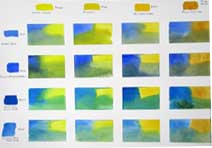 The subject of mixing green comes up several times a year in my classes and workshops. Here's the chart I demonstrated last week in my Hithergreen class on mixing a great variety of greens with the blues and yellows you already have in your paint box. It's worthwhile to take a couple of hours to make this chart so you have a reference for the different greens you can mix, at least until you become really familiar with them by using them often. I use white artist's tape to section the paper into 2-inch squares or slightly larger rectangles. Across the top I put the yellows, one per section: Winsor Lemon, Aureolin, New Gamboge and Raw Sienna are on this chart. Down the left side I place the blues: Cobalt Blue, French Ultramarine, Phthalo Blue Green Shade, and Cerulean Blue. I dampen a square and put a swatch of the yellow in that column in one corner and the blue in the row in the other corner. Then I mingle the two colors on my palette and place the mixture at the bottom of the section, teasing the colors up into the pure colors so I get variations of the mixture throughout. The chart includes spring, summer, late autumn, bright, misty, foggy and sea greens with just one blue and one yellow in each mixture. Before you begin a painting, see if you can find the greens you need on the chart and include those colors in your palette. See also my blog on Mixing With Green.

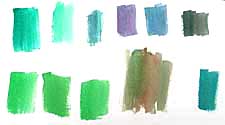 So what we talked about on Monday was taking time out from painting to explore mixing tube greens with every other color on your palette or in your paint box to see what colors you can make. Here are just a few samples. You can make just about any green starting with phthalo green and adding another color in different amounts. In the top row, the first swatch on the left is Winsor Green Blue Shade. Next to it is viridian, which is pretty weak in watercolor and not a great mixer. Below are two swatches of Hooker's green. Everything else was mixed using the Winsor Green and a blue, yellow, magenta or burnt sienna. Try this for yourself and remember to label your swatches in case you want to create the same color later. Using just one green and mixing the others with colors you're using in other parts of your painting makes for much more vibrant, exciting greens that look more natural than tube greens. Try this with other colors, too, and you'll find you can learn to match tube colors. See p. 54 in
 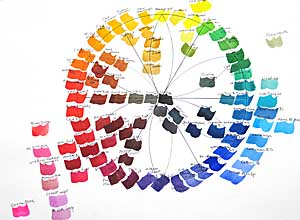 Finally I've finished the watercolor wheel I started for my class several weeks ago. I did blue first, then added red the following week and yellow a week later. (Click on the "color wheel" label below to see the three work sheets and watercolor wheels that I painted last month.) Today I filled in orange, green and violet secondary colors and the neutrals in the center. I finished it in my studio so the class wouldn't lose painting time next week. I'll show them the finished wheel, explain a couple of things and they can examine it more closely later if they wish. Mind you, I'm not advocating having or using all these colors. I want to show that there's a continuum around the color wheel that reveals temperature relativity from one color to the next. This is a good exercise for your "color eye," to see if you can distinguish between warmer and cooler colors and see how their neighbors on the wheel influence their temperature. The colors around the perimeter of the wheel are mostly high tinting-strength, high-intensity colors. Except for a few colors in the red area, outside the perimeter are the low tinting-strength, high-intensity colors. Inside the wheel are the low-intensity colors and neutrals.
 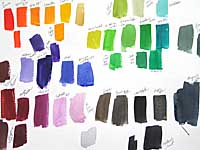 Here's the test sheet for the colors I did today. It doesn't matter whether you make a wheel or swatches, but this is a good way of learning about your paints. As I said in an earlier post, the color wheel above is similar to the one I made for my first