l s

Wednesday, May 25, 2011

A Day with Grammy

Jenna spent the night with us on Monday, and on Tuesday her first day of summer vacation as a third grader entailed a visit to my digital photography show and a fine juried exhibition of the Western Ohio Watercolor Society (WOWS)at the Town & Country Fine Art Center in Kettering. She loves to look at art and point out what she likes--she has a discerning eye. In her suitcase she had packed a picture she drew over the weekend--a big, juicy apple and a bunch of bananas, life-size and in color. I was astonished. An artist at the gallery recognized her from the watercolor I included in The New Creative Artist>. She's used to that. We ran a few errands, then picked up a kit from JoAnn Fabrics so I could begin teaching her to sew. She made a monkey and named him "Banana-Split."

Labels: , , , , , ,

Saturday, May 21, 2011

Art-to-Art Palette Journal

Haven't been blogging and Web site-ing (new verb) much. Thought I'd catch up on Ben Rayman's Art-to-Art Journal. I enjoy reading the artist profiles--kind of a Facebook of the Midwest.

Photoshop Elements class ended last week, so I have recovered one day. I'll miss the class, but I'm glad to have the time back. I learned so much.


My digital photography show is extended to June 19 and I finally got the PR sent out today. I need a manager! (Or a keeper, more like.) I'm taking tomorrow off so I'll be raring to go on Monday on a couple of other projects.

Labels: , ,

Tuesday, February 15, 2011

Digital Photo Printing for Amateurs


I've learned so much from the Photoshop Elements class I'm taking at Hithergreen, but it bugs me that I have to work so darn hard to get good prints. I've been studying books and online and now I know enough to be dangerous, but still struggling with consistency. I shared what I've learned yesterday with the Digital Photography Forum at the Center. Here's a chart I made. The prints are 10.5 x 8. The top row shows what happens when you use cheap paper and the wrong print setting--you waste a lot of ink that soaks into the paper. The middle row shows printer control on better paper. I oversaturated the one on the right to see what would happen. Eeek! On the bottom row I used Photoshop Elements color controls on Office Depot Laser/injet Presentation Paper and Epson Ultra Premium Luster Paper, my favorites. The last print is the best and shows more detail than any of the others.

Labels: , , ,

Tuesday, March 17, 2009

Taos creative Photoshoppers


Jerry Walter and Rick Finney continue to amaze me with their digital photographs altered in Photoshop, shown here. I asked Rick to send me some information on his process in the florals, and I confess it's way beyond me: gradients, masks, layers, frames, hyper-tiling and watercolor effects. Jerry's soft image is a watercolor effect. I offer these images to give you an idea of what creative artists can do with Photoshop. I love painterly images where distinctions between painting and photography disappear.

Labels: , ,

Sunday, March 01, 2009

Friday adventures downtown

I went to downtown Dayton to deliver a copy of Confident Color to the Graphics Terminal team that photographed some of the work for the book--in fact, for all of my books, since 1983. I enjoyed watching Greg page through the book, stopping to study pieces he remembered photographing. Ed walked through and reminded me to read a letter posted on the counter. Like most photo labs, GT is phasing out film and in a few months will no longer be doing transparencies and slides. I'm not surprised. Some of the artist contributors in my last two books had trouble finding "wet labs" to process film. I enjoyed working with the digital photo files for several reasons, one of which was the capability of seeing the image in all its glory on my monitor. Looking at slides and transparencies on a light-box doesn't begin to compare. The main problem I had with digital was getting the artists to follow the instructions, briefly, using a quality 7+MP (preferably, 10 MP) camera with a good lens (not a point-and-shoot), saving at 300 dpi sized to 9" x 12". Those were my publishers specs. I also required a Kodak color strip to be in the photo frame to aid in color correction. I've decided that all submissions for my next book, whatever it might be, will be digital.

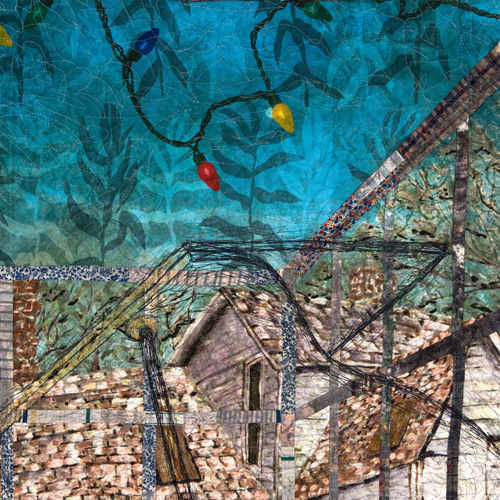
After I left GT, I drove around the block to the Dayton Visual Artists Center to see the two shows currently installed. Jeana Eve Klein combines creative quilting and painting in her large quilts (detail shown). Her small quilt squares are spectacular color abstractions. Bridgette Bogle's playful acrylic paintings on small canvas squares are colorful interpretations of popular motifs. Both shows are delightful and run through the end of March.

Labels: , ,

Saturday, October 18, 2008

Something unusual

Recently I began attending the Digital Camera Club at Hithergreen Center. I became interested in photography when I bought my first digital camera in 1998, a low- resolution Sony Mavica. I was amazed at what I could do with the camera and some simple software. I've learned a lot since then and have upgraded cameras several times (now using a Canon G6), but I often feel frustrated with no one to critique my photographs or lend a hand when I'm having a problem. It's incredible how much I've learned in just two meetings. The presenter gives everyone a "practice card" with suggestions for shooting images. Sometimes the group goes out for the last half hour and shoots on the center grounds, and sometimes they bring in something they've done elsewhere. I shot this photograph at Hithergreen. It was quite a challenge. The suggested subject was "something unusual."

Labels:

Tuesday, October 02, 2007

Feelin' good

My editor stopped by this morning and picked up the new book. I was beginning to wonder if I would make the deadline. My daughter stepped up and helped to proofread the art numbers on the manuscript and flat plan, then the artists' permissions and the art log, which are both huge jobs. I couldn't have made it without her help. Granddaddy entertained the four-year-old while the baby slept at Grammy's feet as she worked. What a scenario. One of my students volunteered earlier and I put her to work taping vellum overlays onto 150 small pieces of art, another time-consuming job.

Sometime I may blog about what I learned about digital art submissions for books, if anyone is interested. It has been quite a learning experience. I think it will all turn out all right. I did have to go back and re-do all the images as I finished up the captions and the manuscript, but it was worth it.

Tomorrow morning I leave for Montana to teach a workshop and judge awards for the show I juried in June by slides. This will seem like a vacation. In the last workshop two weeks ago in Louisiana I worked on the book in the mornings before workshop and until late at night after class. I'm looking forward to being in the West--it has been awhile.

Labels: , , ,

Tuesday, August 07, 2007

Not whelmed, but overwhelmed

When I was working on my previous book, The New Creative Artist, several of the artists asked to submit their artwork digitally. The production department at North Light Books wasn't too happy about it, but they allowed it. Since that time, North Light has emerged into the digital world and now they provide authors with very helpful instructions for preparing their artwork both on film or digitally.

Now I understand why they were reluctant to go digital. Not only are the artists not up to speed on the requirements, many professional photographers don't have a clue how to shoot and finish digital submissions. About half of my artists for my new book (which, by the way, has finally been titled: Confident Color: An Artist's Guide to Harmony, Contrast and Unity) have submitted digital files. I provided an information sheet for each one and about half followed the directions. This is driving me nuts. I spent six hours yesterday sizing, fixing perspective, matching colors and working up a demo for an artist who used a professional photographer to shoot his work. I asked everyone who did a demo to use a gray card which North Light provided so we would have a good color control. So far, most of them "forgot to use the gray card." Today I worked with another demo artist who had her final work shot by a color lab. The color is so far off I couldn't believe my eyes. Yes, it has the color scale, but why should we have to use it? There's no excuse for such poor results.

I'm still trying to figure out why this is happening. The only thing I can figure out is that people are being way too casual about the benefits of digital photography. Sure, you can fix it in Photoshop. But if you use the correct settings, set up with a tripod and good lighting--and a gray card--you shouldn't have to Photoshop it to death. It may seem easy on your end if you're the artist or photographer, but please, pity the poor production artists who have to make everything look good in the book. Pity me, using the work of 45 artists and having to get everything in shape to send to the production editors.

Let's face it--slides and transparencies are on their way out. So-called "wet labs" are closing or transforming into digital labs. So if you're illustrating books or entering shows that allow or require digital entries, do yourself a favor (and everyone else) and either find a good (VERY GOOD) digital lab to shoot your images or buy a good (VERY GOOD) digital SLR and LEARN HOW TO USE IT PROPERLY. Oh, pardon me, am I shouting?

Labels: , , ,

Thursday, April 12, 2007

Photographing art for reproduction

Every time I write a book I get tied in knots over photographing the art. Through the years I've had pretty good success with an SLR, slide film and photofloods, even though I had to go through some ridiculous contortions to fit my equipment into the space in my studio. When I needed 4 x 5s I just went to Graphics Terminal color lab downtown. For The New Creative Artist some artists sent digital images, which I hadn't dealt with before in submitting to the publisher. We had quite a go-around until they agreed to look at them and see if they were acceptable. Since they had all been done by professional artists, of course they were just fine. Most of the artists sent slides or transparencies. Now it seems that the publisher's graphics department is more open to digital submission, but they are setting the bar pretty high for most artists--10 million pixels, separate macro lens, no zoom lens, 4800K photofloods, and other specifications that make it almost impossible for most artists to comply if they don't already have the equipment. They do mention that 7 MP would be fine if the repro is going to be less than 8 x 10, but just in case they want to use it for the cover or full-page chapter art, it should be shot at 10 MP. I talked to my camera guy today at Fairborn Camera and he recommended a Nikon D30X (I think that's what he said) if I plan to upgrade from my Canon G6, but I'm not sure I want to get into that. The problem, of course, is the step-by-step demos, which you can't run down to the color lab to get shot at every stage. What's my point? I don't know, I'm just thinking out loud here. Should I get out my Pentax SLR and photofloods and do it the old-fashioned way or tackle the learning curve of a new camera while I'm trying to write a book? 'Tis a puzzlement.

Labels: ,

Thursday, January 25, 2007

Scrapbooking--an art for everyone

My name is Nita. I'm a Scrapaholic. I've been scrapbooking for one day. I admit I enjoyed it. Here's my story. In 1998 I launched my web site www.nitaleland.com. I bought a digital camera so I could put pictures on my web site. In 2001 I upgraded my camera and began taking photography seriously, photographing wildflowers in Ohio, Colorado, Arizona and Massachussetts. I used a computer progam to print out pages of my pictures and put them in big notebooks. In a short time I was a Photoholic, but that's another story.
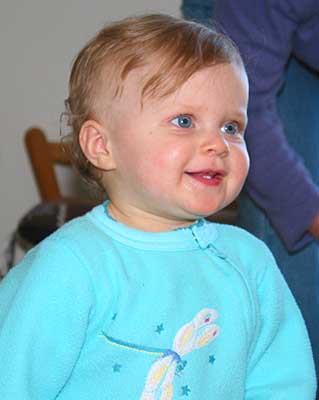

In 2002 our granddaughter, aka The Little Artist, was born and my photo habit accelerated. I was getting out of control. But I continued to print out pages, only this time the main subject was the baby, although I still photographed wildflowers. Three years ago my niece, who was a Creative Memories consultant, gave my daughter and me a lesson in scrapbooking. We both bought all the stuff--albums, croppers, snippers, scissors, templates--you name it. My daughter made albums of baby pictures while her husband was deployed in Eastern Europe. I sorted our family photos into shoe-sized photo boxes which are neatly stacked but haven't been opened for two years. The scrapbooking supplies are dusty. The pens may be dried up; I haven't checked.
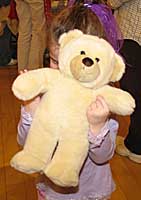
Which brings me to my confession: on the occasion of our granddaughter's fourth birthday party at Build-a-Bear last weekend, I took 285 digital photos. Before you start throwing memory cards at me, let me explain the obvious fact that seven four-year-olds and their parents tend to move pretty fast and I expected a lot of blurry photos. There weren't that many. Still, I culled the photos down to about 125 and decided to make a SCRAPBOOK. A real one, not printed album pages.

I went to Scrapbook Studio at a Cord Camera shop. I found a 9" x 9" scrapbook that was Jenna's favorite color--lavender--with ten pages (twenty counting the backside). Just the right size for her--those 12" x 12" scrapbooks are cumbersone. I bought three purple background pages and two multicolored pattern pages, plus three sticker packs. Then the work began. It takes a long time to print enhanced photos, so I did some multi-tasking while the photos printed.
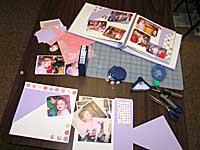
Yesterday I put the book together and got deep into the addiction. Sorting, cutting, cropping, arranging, adhering--this is one of the most labor-intensive projects I've ever done. And it's fun! Just playing with the background designs was fun. So was arranging the photos to tell the story of the Big Day. I finished eight of the pages in time to show them to the family at Jenna's birthday party for the Grandparents last night. I haven't written anything on the pages yet and am trying to decide whether to use the computer or handwriting. (Is there a transparent sticky-paper that you can inkjet print on?)

Well, I enjoyed scrapbooking, but it will be awhile before I do that again. Just wanted you to know that anyone can do scrapbooking--and you'll be surprised, if you try it, at how much you'll learn about design and color. Don't worry about becoming addicted. You can walk away, just like I did. Uhmmm. Where are my scissors? my oval template? Just...one...more...page....

Labels: , , ,

Thursday, January 04, 2007

Editing the holiday photos

Off and on I've been working on the pictures I took over the holidays. I don't take nearly as many as I did when our granddaughter was a baby because I don't see her as much. But I still tend to shoot and shoot and shoot in the hopes of getting some really good ones, and it seems to work. There is still some editing necessary, though. That's why I love Photoshop Elements 5, which I recently updated from PSE 3. I have thousands of pictures in the Organizer and can find them with a click. Get rid of red-eye with a click. Resize with a few numbers and a click. It's so easy. I finally am getting the hang of layers--putting corrections on separate "pages" so you can change each one individually or delete without ruining everything else. I suppose everyone has their favorite editing program--but this one is better than anything else I've used. Amazon has a discounted price and a $20 rebate right now, so it's $66.99 instead of $99.99.

Labels: , , ,

Wednesday, November 29, 2006

Time flies when you're sorting photographs

Wow. Where did the last ten days go? I've been glued to my computer and haven't even had time to blog. What's up with that? I've been obsessively getting my image files reorganized onto my new external hard drive and reconnecting the files to the new PhotoShop Elements 5 program. What a job! I probably made more work for myself than I needed to by uploading my backup CDs to the new drive instead of selecting the files to save, but I was hoping to find some that got lost over the years.

Early in my computing days I scanned photos into my computer, but after I bought my first digital camera--a Sony Mavica--in 1998, I never used film again. It was so easy to take a shot and download (upload?) it to my computer that I didn't even mind that the resolution was so low--way less than 1MP in those days. But, as with most things electronic, I upgraded twice and by 2001 switched to a Canon G1, then in 2002 a Canon G2, and in 2004 a G6. Love those Canons. The G-series isn't as small as a pocket camera or as large as an SLR (the Mavica was too bulky for me) but is small and easy to handle, fully featured and has great optics. Plus, I love the swivel LCD.

My first objective in 2001 (my justification for spending so much on the camera) was to become a better photographer. I got fantastic closeups of wildflowers in Ohio, Colorado and Massachusetts and at the same time learned a lot about botany. In 2003 I focused on (pun intended) photographing our new granddaughter and have taken literally thousands of photos of her. The camera loves her.

By the time I got all these photos saved to the new hard drive and entered into PSE 5, I had more than 23,000 photos. After working diligently and not getting anything else done, I've deleted most of the dupes and the duds. The number is now down to around 12,000. I could probably delete a few more duds, but I've had it with photos for now. I do love digital photography, though, and I'm looking forward to photographing some of my work for the new book. Next year I'll be judging a show that may offer digital submissions, which will be interesting, too.

If you haven't gone into digital photography yet, check out my article on my web site for some guidelines on selecting a camera.

Labels: , , ,

Monday, July 31, 2006

Digital image delivery

I just finished an article over the weekend for Watercolour Gazette magazine, a Canadian publication produced by Eileen Korponay of Winnipeg, Manitoba. The mag started over thirteen years ago in a newsletter format and has become a very nice, useable resource with lots of ideas, tips and techniques. I've written several articles for Eileen over the years and she has reciprocated by reviewing my books. I used snail-mail to send small illustrations to her for my articles, but this time I had some digital images I wanted to use. I converted my high-resolution tiff files to grayscale and adjusted the value range where needed. Then I resized the files to 200 dpi at a print size of about 5" x 8". The files were still pretty big--between one and two MB--so I sent six emails with a different file in each. I have broadband, so I could have put more than one in each email, but I wasn't sure Eileen has it. She says they came through just fine and she was able to set up the article quickly with the digital files. Wow, this is the way to go. The article will appear in the September issue. The title is "All Art is Abstract."

Labels: , ,

Thursday, January 05, 2006

Digital photography resource

Here's an interesting blog on Color in Digital Photography: Introduction to Color Theory. The principles apply to printing and computing, as well. Plus, here's a link to an article I wrote on Harmony and Contrast of Colors, which is recommended by the photography site.

Labels: , , ,

Tuesday, January 03, 2006

Where did all the Gigabytes go?

My first computer was a KayPro "portable," 24 pounds of mean machine with 8K of RAM. No, "8K" isn't a typo. It was 1982 when I became obsessed with the idea of owning a personal computer. I read an article that said the Kaypro was reliable and less expensive than the new, more powerful IBM PCs, plus bundled software was included. It had two 5 1/4" floppy drives. After turning on the machine, I inserted a floppy with the operating system on it and loaded the system into the machine. Then I inserted a the word-processing program floppy. After loading the program, I removed the floppy disk and inserted a data disk. The machine had a "swap file" of a designated amount of space and would swap your work between the memory and the data disk as you worked with a file. When you were finished, you saved your file to the floppy and removed the disks after closing out the programs. I clearly remember saying, "This is so great, I'll never need more than this."

Power corrupts and computer power corrupts absolutely. I upgraded to a Kaypro II in a short time and, within five years, to IBM PCs. It wasn't long before I was talking megabytes and gigabytes. Which is why this is on my mind. My current computer is middle-aged (going on three in May). I thought it was a monster at 512MB RAM and a 56GB hard drive. Last week it was slowing down some, so I did some checking and discovered I had 4 GB left on my hard drive.

I couldn't believe it. I spent most of last week trying to recover some disk space and eventually got up to 16 GB (couldn't afford to buy an external hard drive so soon after Christmas!). The problem, of course, is the digital photos. I've gone through five digital cameras, starting with less than a megabyte up to 7 MB. Plus I save the best ones as TIFF files, which are very big, before editing. So I had all those files and different versions of them, when all I needed was the final file and the original. I'm sure I can save some more space, but I'm looking into PhotoShop Elements 3's backup-to-CD system to save the day. And I'll have to get an external drive eventually.

Did I mention that our only grandchild was born the same year I got the computer? That's where the Gigabytes went.

Labels: , ,