Compact fluorescent light bulbs
I'm trying very hard to shed some light (sorry about that) upon these new bulbs. I've read that it is energy efficient to use them instead of incandescent bulbs, and although they're more expensive, they last much longer. I bought a spiral fluorescent bulb several years ago, but it was too big for any of my lamps. Now they come in compact and mini sizes, so that solves the size problem. The next issue is to figure out the watts you need. Fortunately, the packages give the equivalents in both fluorescent and incandescent, but sometimes you have to search for it. The new fluorescents don't seem to throw light as far, as we discovered when we put them into our reading lamps, but since you're sitting still, that doesn't matter much. Also, they worked just fine for the living room lamps and for the one that's on a timer. But we did have to experiment with the temperature, as there's a whole different range out there. The "craft" light is 5000 Kelvin full spectrum, same as my studio overhead lights, but it doesn't work for a reading lamp. There's one that is "daylight" at 6500K that is way too cool for any uses I can think of. The one I liked is 100W daylight Sylvania at 3000-3500K and has a nicely balanced color that isn't too warm or too cool. I found the best selection at Lowe's.
Labels: full spectrum, kelvin, lighting
posted by Nita at 1:47 PM
3 comments


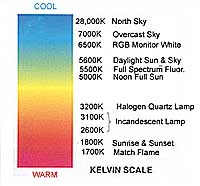 When I set up my studio in 1983 I consulted a lighting specialist who advised me to buy fluorescent lighting that was 5500 degrees Kelvin. Whatever that meant. I followed his advice and found that the lighting was ideal for my color studies and painting and have recommended to my students that they use this kind of lighting in their studios. A couple of weeks ago I showed my class what a difference it made in my color charts to see them under a portable Ott-lite. The classroom has regular fluorescent lighting in it. I went to the Internet and found several charts, which I combined into the one you see here. The best lighting for artwork is in the range of 5000-6000K. The Color Rendering Index (CRI) should be 70 or higher for excellent, 60-70 for good color matching. Anything under 60 is unacceptable. There are several companies that make lights that meet these specifications. Google